
RSS

Blog

Trending Jewelry: Small is BIG!

We just came back from the second biggest jewelry trade show in the western hemisphere: the JIS Miami Show. Once again, it has confirmed one of the hottest trends in today’s jewelry design: small is BIG! Read this blog post and find out the consumer behavior shift and the reason behind "Small is BIG" jewelry trends.

How Creators Can Set Up for a Successful Show or Convention on a Budget

Creative people have many more options these days when it comes to making money from their art. With the addition of websites that provide sales platforms for handmade items, the internet has become a huge boon for individuals who make art, crafts, and other goods. Not only that, craft shows, conventions, and art fairs have grown in popularity in recent years as people search out niche markets for creative items they can’t find anywhere else. When you’re ready to tackle one of these shows, do a little research to figure out the best way to set up and prepare.
Marketplace Risks for Jewelry Businesses and How to Avoid Them

As a wholesale jewelry supplier, we work with thousands of designers around the world and we are able to notice when there are ups and downs in their sales, as it affects ours as well. We dug deeper and noticed that some shops suffered as they only sold on the online marketplace platform.

Types of Clasps

An important aspect of a jewelry piece design is the clasp. The clasp may not be the most noticeable component but it is the most functional when it comes to wearing a piece and securing it into place.  In some cases, the clasp can also become a striking part of the design too.

There are so many types of clasps to choose from so here is a guide to help explain what options are available and how to use them.

Types of Earring Findings

Stud earrings are simple earrings that consist of a straight post that goes through the ear piercing and has a small adornment of a stone, metal ball, or shape that is attached.  The first earrings you wear after piercing, studs create the illusion that the adornment is floating on an earlobe, as the post and backs are not visible.  Common backs that keep the posts in place are butterfly backs, also known as friction backs, or screw backs, that literally screw onto the post.   


Alternatives to Karat Gold: Gold Plated, Vermeil, and Gold Filled

Gold has been a captivating precious metal since ancient times and a favored material for jewelry making ever since, due to its rich natural yellow color. Pure gold has commonly been associated with power, immortality, and beauty in many cultures around the world because it does not corrode or tarnish. Today gold is still very beloved and fashionable but many hand-made or fashion jewelry lines do not use solid Karat gold because of the costly expense due to its rarity. So what alternative gold material options are available and how do you decide which one to use? 

Basic Jewelry Findings Terms

Basic Jewelry Findings Terms


Findings: The component parts and materials used to complete a piece of jewelry.


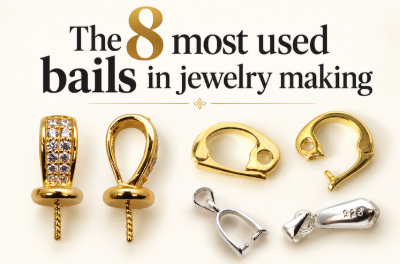
Bail: Components used to easily attach pendants or charms to a chain without the soldering being required.


Bead: A small, often rounded piece, with a hole through it so it can be strung. Beads can be made from a variety of materials. 


Bead Cap: A metal ornament, which is used to highlight beads and turn them into a focal piece.  They are also used to cover up any imperfections or damage around the drilled hole of the bead.


Bezel: A metal ring that holds a stone in its setting.


Cabochon: A highly polished gemstone used in bezel settings.  They have a curved top and flat bottom to allow them to sit in the settings.


Clasp: A device that allows the two ends of a chain to close together. They can be functional and decorative, coming in many styles and shapes.

-Lobster Claw Clasp: With the look of a lobster claw, it has a rounded top with a self-closing bottom hinge that opens when a small lever is pushed.

-Spring Ring Clasp: A round hollow ring with an inner wire that is opened and closed by pulling and releasing a lever on its side.


-Magnetic Clasp: Attracting magnets on each end are used to close securely and open easily.

-Toggle Clasp: Has a bar that is pulled through a ring and cannot pass through again, making it secure.


Crimp Bead: A small round or tubular hollow bead that is secured to jewelry by flattening it with pliers. Often times they are used to secure clasps or floating beads on stringing material.


Earwire: A curved and looped piece of wire that is one part of an earring.  The curved part fits through the piercing of an ear and a loop is used to dangle a decorative finding.


Faceted Stone: A polished gemstone with many flat cut surfaces called facets.  This helps the gem reflect light, making it look brighter and shimmer.


Gauge: The thickness measurement of wire or metal. The higher the number is, the smaller the size.


Gold Filled: Legally required to contain 1/20 gold by weight and more valuable than gold plated. It will not tarnish or fade over time like gold plated due to a different bonding process.


Gold Plated: Covering another type of metal with a thin layer of gold using electroplating.


Half-drilled Bead: A bead that only has a hole halfway through it and can be glued onto metal pegs to create charms, pendants or stud earrings.

 Jump Rings: Small, round connectors used in jewelry making. 

-Open Jump Rings: Have a divide in the wire that can be pried open and closed using pliers.

-Closed Jump Rings: Cannot be opened as they are soldered shut. They are ideal for projects that require a stronger connector for heavy or expensive pieces.

 Oxidization: A reaction that occurs when sterling silver is exposed to oxygen, sulfur, and moisture in the air over time that results in a dark tarnish on its surface. Some jewelers purposely give a black patina to sterling silver by using chemicals to speed the process up.


Pave: Tiny gemstones set close to one another with no visible metal that results in a “paved” stone surface look.


Pins: Straight pieces of wire, which can come in many gauges and lengths.

-Ball Pins: Have a small ball at the end to prevent beads from sliding off. Loops can be created with pliers to attach to other findings. 

-Eye Pins: Have a small loop at the end. The loop can be attached to other findings to make longer pieces.

-Head Pins: Have a flat or round end that keeps beads from sliding off. Loops can be created with pliers to attach to other findings.


Quality Tag: A small, flat piece of metal that has the metal quality stamp or trademark of the manufacturer or artisan. They usually have a hole on each end to easily attach to the chain with jump rings.


Rhodium Plating: Done like gold plating with electroplating, rhodium plating is used to prevent scratching or tarnishing on sterling silver.  Rhodium is a precious metal of the platinum family and is also a good option for those with nickel allergies as it is hypoallergenic.


Rose Gold: Done like gold plating with electroplating, rose gold is a combination of specific amounts of silver, copper, and gold. 


Slider Bead: A bead with an inner silicone layer that allows the bead to grip chain or cord.  The silicone allows the bead to stay in place while also making it easy to adjust its position if needed.


Sterling Silver: An alloy of silver with a silver content of 92.5%silver. The remaining 7.5% is of other metals.


Wire wrapping: Using wire around a bead, stone, other findings, or itself, to create pendants, charms, or decorative patterns for jewelry pieces.


Vermeil:  Vermeil is a combination of sterling silver and gold, usually a sterling silver core with thicker gold plating of 2.5 micron thickness.


Explore all of the findings AZ Findings has to offer: https://www.azfindings.com/wholesale-jewelry-findings

You have no items in your shopping cart.