
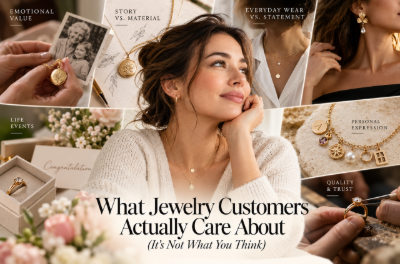
What consumer research reveals about emotional value, personal stories, everyday wear, life milestones, and the real reasons people choose jewelry.
When jewelry designers create a new collection, they often focus on materials, craftsmanship, gemstone quality, design details, and the latest fashion trends. These are important considerations, but they don't always explain why a customer chooses one piece over another.
Why might someone treasure a simple silver necklace more than an expensive gold one? Why does a modest birthstone bracelet become something a person wears every day, while a spectacular statement necklace rarely leaves the jewelry box?
The answers have much to do with how jewelry makes people feel, what it represents, and how it fits into their lives.
Recent consumer research from Jewelers Mutual, McKinsey, and The Plumb Club reveals a more complex picture of jewelry buying behavior—one in which emotional connection, personal expression, practical wearability, and quality all play important roles.
For jewelry designers, makers, and retailers, understanding these motivations can be just as valuable as understanding the materials themselves.
1. Emotional Value: Jewelry Is More Than an Accessory
Unlike many fashion accessories, jewelry often develops a deeply personal significance that has little relationship to its original purchase price.
A necklace received from a grandmother, a bracelet exchanged between friends, or a ring purchased after a personal achievement can become emotionally irreplaceable.
A [2024 Jewelers Mutual consumer study](https://www.jewelersmutual.com/resources/individuals/how-buy/jewelry-buying-behaviors-consumer-study), involving more than 1,500 U.S. fine-jewelry owners, found that love and joy were the strongest emotions associated with buying or receiving jewelry. More than half of respondents said losing a treasured piece would cause significant sentimental loss.
This highlights an important distinction: The financial value of jewelry and its emotional value are not necessarily the same.
A $50 bracelet might carry more personal meaning than a $5,000 necklace. The expensive piece may have greater intrinsic or resale value, but the inexpensive bracelet could represent an unforgettable friendship or experience.
For designers, emotional appeal doesn't necessarily require expensive materials or elaborate craftsmanship. Sometimes a simple, thoughtfully designed piece provides exactly what the customer is looking for.
The opportunity lies in creating jewelry that people can connect with, not simply jewelry they can admire.
2. The Story Behind the Jewelry Can Matter More Than the Materials
Jewelry professionals naturally describe products in technical terms: sterling silver, 14K gold-filled, natural gemstones, rhodium plating, or handmade craftsmanship.
These details help communicate quality and value. However, customers may approach the same jewelry from an entirely different perspective.
Consider a necklace featuring three small birthstones. A designer might emphasize the gemstone quality, metal composition, and setting. The customer might see something else entirely: a representation of her three children.
The emotional meaning comes from what the jewelry symbolizes.
There are two kinds of storytelling that can make jewelry meaningful.
The designer's story might involve artistic inspiration, traditional craftsmanship, cultural influences, or the origin of a material.
The customer's story develops through personal experiences, relationships, memories, and the significance they attach to the piece.
The second can be especially powerful because customers become part of the story themselves.
A charm purchased during a vacation becomes a reminder of that journey. A pearl necklace worn at graduation becomes connected to a milestone. A handmade bracelet created during a gathering with friends carries memories beyond its physical design.
For independent designers and small jewelry brands, this creates opportunities to develop collections around meaningful symbols, places, experiences, or themes.
Of course, storytelling should complement genuine product quality, not replace it. Beautiful stories cannot compensate for poor craftsmanship or misleading material descriptions.
But when good design and authentic meaning come together, a piece can become far more memorable.
3. Everyday Wear vs. Statement Jewelry: Two Different Customer Needs
Jewelry often serves two very different purposes.
Some pieces are designed to attract attention. Others quietly become part of a person's daily identity.
Statement jewelry—bold necklaces, oversized earrings, sculptural rings, or colorful gemstone designs—allows customers to express creativity, celebrate special occasions, or create a distinctive look.
Everyday jewelry serves another purpose: it needs to feel natural, comfortable, and versatile enough to wear regularly.
Research suggests everyday wear deserves serious attention.
The 2024 Jewelers Mutual study found that only 7% of surveyed fine-jewelry owners reserved their jewelry exclusively for special occasions. Most wore their pieces at least occasionally throughout ordinary life.
For jewelry designers, that finding raises practical questions.
Is the necklace comfortable for extended wear? Can the bracelet be fastened easily? Does the design work with different outfits? Will the jewelry withstand the kind of use customers reasonably expect?
Features such as adjustable chain lengths, secure clasps, lightweight construction, smooth edges, and versatile styling can substantially improve the wearing experience.
This doesn't mean designers should abandon bold or artistic creations. Statement jewelry fulfills a genuine desire for individuality and visual impact.
The important distinction is understanding the purpose of each design.
Customers may purchase statement jewelry to express a particular mood or occasion, while everyday jewelry becomes part of how they see themselves.
Both categories have value, but they satisfy different needs.
4. Life Events: Jewelry Becomes a Physical Reminder of Important Moments
Jewelry has long been connected to milestones—engagements, weddings, anniversaries, birthdays, graduations, and the arrival of a child.
What makes jewelry particularly suitable for these moments is its lasting nature.
Flowers fade, celebrations end, and vacations become memories. Jewelry remains as a tangible reminder of the occasion.
However, jewelry purchasing is no longer limited to traditional gift-giving or major celebrations.
A [2026 Jewelers Mutual self-purchaser study](https://www.jewelersmutual.com/newsroom/jewelers-mutual-reveals-how-and-why-consumers-buy-fine-jewelry-themselves) found that birthdays, holidays, and spontaneous self-reward remain important motivations for purchasing fine jewelry. Nearly 60% of surveyed self-purchasers considered themselves jewelry collectors.
People increasingly purchase jewelry for themselves to celebrate career achievements, personal progress, or simply because they want something beautiful.
These occasions don't necessarily require elaborate or expensive designs.
A small gemstone pendant might celebrate a birthday. A personalized charm can recognize a graduation. A simple ring might serve as a personal reward after reaching a long-term goal.
For designers, thinking in terms of life events rather than only product categories can inspire new collections.
Instead of developing another group of necklaces or bracelets, consider the moments people might want to remember—and what kind of jewelry would help them do that.
5. Personal Expression: Customers Want Jewelry That Feels Like Them
Personal expression is becoming an increasingly important driver of jewelry demand.
According to McKinsey and The Business of Fashion's [State of Fashion 2026](https://www.mckinsey.com/industries/retail/our-insights/state-of-fashion), 71% of consumers surveyed said jewelry helps express their personality, while 75% preferred designs that are creative or unique.
These findings suggest that jewelry buyers are interested in more than simply following popular trends.
They want pieces that reflect their individuality.
For some customers, that means minimalist gold chains. For others, it might mean colorful gemstones, unusual shapes, mixed metals, or bold handcrafted designs.
Personalization adds another dimension.
Initial pendants, birthstone jewelry, engraved charms, interchangeable components, and layered necklaces give customers opportunities to create combinations that feel distinctly their own.
Importantly, personalization doesn't always require custom manufacturing.
Modular designs, charm collections, adjustable chains, and mix-and-match components can allow customers to make personal choices using existing jewelry pieces.This presents an interesting opportunity for designers: instead of designing every detail of the finished look, create flexible collections that allow customers to participate in the creative process.
A design that can evolve with someone's preferences or experiences may remain relevant long after its original purchase.
6. Quality, Price, and Trust Still Matter—Perhaps More Than Ever
Emotional connection and personal expression help explain why customers desire jewelry. But desire alone doesn't guarantee a purchase.
Customers still want confidence that the jewelry is well-made, reasonably priced, and appropriate for its intended use.
The [Plumb Club's 2025 consumer research](https://www.jckonline.com/editorial-article/consumers-prefer-independents/) found that quality was the leading purchase consideration, ranked first by 39% of respondents. Design followed at 21%, price at 17%, and uniqueness at 12%.
The survey focused on relatively affluent, college-educated consumers, so its findings shouldn't be treated as representative of every jewelry buyer. Nevertheless, they reinforce the importance of combining emotional appeal with tangible product value.
Customers may not understand every technical difference between jewelry materials, but they still care about durability, appearance, comfort, and reliability.
A customer purchasing gold-filled jewelry, for example, may be less concerned with the technical manufacturing process than with understanding how it differs from gold plating, how to care for it, and what kind of longevity to expect.
Clear and accurate descriptions help bridge that gap.
For jewelry designers and brands, trust is built through consistent craftsmanship, transparent material information, realistic durability claims, and designs that meet customer expectations.
A meaningful story may attract a customer, but dependable quality helps earn lasting confidence.
What This Means for Jewelry Designers and Brands
The research points toward a broader way of thinking about jewelry design.
Rather than beginning every collection with materials, techniques, or trends, designers can also begin with the customer.
What experiences are they celebrating? What memories do they want to preserve? What personal style are they expressing? How and where will they actually wear the jewelry?
These questions can influence everything from design concepts and material choices to sizing, functionality, and product presentation.
A simple, comfortable necklace with a meaningful charm may appeal to one customer. An elaborate statement piece expressing bold individuality may be perfect for another.
Neither approach is inherently better. Both succeed when the design connects with the customer's needs and expectations.
The strongest jewelry collections may be those that combine several dimensions of value: thoughtful design, reliable quality, practical wearability, and an opportunity for personal meaning.
Ultimately, customers don't evaluate jewelry solely by its metal content, gemstone specifications, or craftsmanship.
They also consider how it makes them feel, what it represents, and whether it belongs in their lives.
For jewelry designers, understanding the person who will wear a piece can be just as important as understanding how to make it.
Research References
1. [Jewelers Mutual — Jewelry Buying Behaviors: Consumer Study](https://www.jewelersmutual.com/resources/individuals/how-buy/jewelry-buying-behaviors-consumer-study), August 2024.
2. [McKinsey & The Business of Fashion — The State of Fashion 2026](https://www.mckinsey.com/industries/retail/our-insights/state-of-fashion), November 2025.
3. [Jewelers Mutual — How and Why Consumers Buy Fine Jewelry for Themselves](https://www.jewelersmutual.com/newsroom/jewelers-mutual-reveals-how-and-why-consumers-buy-fine-jewelry-themselves), February 2026.
4. [JCK — Consumers Still Prefer to Buy Jewelry at Independents](https://www.jckonline.com/editorial-article/consumers-prefer-independents/), reporting The Plumb Club's 2025 consumer survey, April 2025.
Leave your comment