
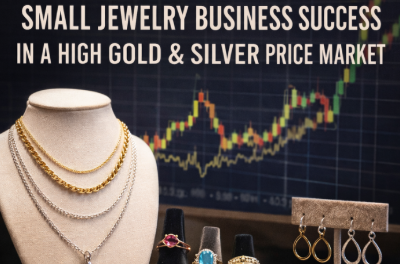
Gold and silver prices periodically reach record highs. When that happens, small jewelry businesses immediately feel the pressure: raw material costs increase, margins shrink, and retail prices have to rise.
For many independent jewelers and designers, the first reaction is concern that higher metal prices will slow sales. While that can happen in certain segments, history shows that jewelry demand rarely disappears during high precious-metal markets. Instead, the industry adapts.
Consumers adjust their buying habits, designers rethink materials and construction, and businesses that adapt creatively often emerge stronger.
For small jewelry businesses, understanding these shifts is key to staying profitable.
How high precious-metal prices change consumer behavior
When gold and silver prices rise sharply, customers usually do not stop buying jewelry. Instead, they adjust how they buy.
One common change is that buyers begin choosing lighter pieces or smaller designs in order to stay within the same budget. Many consumers still spend similar amounts, but they purchase less metal weight.
Another shift is that meaningful purchases remain strong while casual purchases decline. Jewelry connected to important occasions—weddings, anniversaries, gifts, or personal milestones—tends to hold up better than impulse fashion purchases.
High metal prices also make customers more aware of the value of the metal itself. Trade-in programs and recycling become more common, as people bring in older jewelry to offset the cost of new pieces.
Overall, consumers become more focused on design, durability, and emotional value, rather than simply how much metal a piece contains.
Which jewelry segments are most affected
The segments that feel the greatest impact are those that rely heavily on metal weight and price competition.
Customers in the mid-market—those who want genuine precious metal but have strict budgets—are often the most affected. These buyers are the first to switch to lighter pieces, lower karat gold, or plated alternatives when prices rise.
Products whose value is directly tied to metal weight are also more vulnerable. Plain chains, bangles, thick hoops, and other metal-heavy designs become harder to sell when customers begin comparing price to grams.
By contrast, design-driven and higher-end jewelry tends to be less affected. Customers in this segment are paying for craftsmanship, design, and brand identity—not just the metal itself.
This is why luxury jewelry brands often remain resilient during periods of rising metal prices.
What history shows: jewelry businesses adapt
The jewelry industry has gone through multiple precious-metal price spikes in the past. Major surges occurred in the late 1970s, again around 2011, and recently during the 2024–2025 precious metal rally.
Each time, jewelry businesses responded with innovation rather than retreat.
Designers began using lighter construction techniques, such as hollow chains or electroformed designs, to maintain visual presence while reducing metal usage. Lower-karat gold became more common, and silver gained popularity as a more affordable alternative.
These periods also sparked creativity. Jewelers experimented with mixed metals, gemstones, textures, and surface treatments to create visually rich designs without relying entirely on metal weight.
The lesson from history is clear: when precious metal prices rise, successful jewelry businesses shift their focus from metal quantity to design creativity and customer value.
Strategies for small jewelry businesses
For independent jewelers, competing purely on metal price is nearly impossible when precious metals become expensive. Instead, success comes from shifting the value proposition.
1. Focus on craftsmanship and design
Independent jewelry businesses have an advantage that mass retailers often lack: originality.
When metal prices are high, customers are more willing to pay for jewelry that feels unique and thoughtfully designed. Pieces that highlight craftsmanship, distinctive design, or artistic detail stand out more than products that simply compete on price.
Design elements such as gemstones, textures, layered construction, or interesting finishes can create strong visual value without requiring heavy metal weight.
For independent designers, creativity becomes the biggest competitive advantage.
2. Create experiences around jewelry
Another way small businesses can differentiate themselves is by offering experiences, not just products.
Services such as permanent jewelry, custom engraving, jewelry-making workshops, or charm styling sessions turn jewelry purchases into memorable events. In these situations, the value of the purchase is not just the metal—it is the experience and the story behind it.
Experience-based jewelry businesses have become increasingly popular because they build stronger emotional connections with customers.
3. Use alternative materials wisely
High metal prices encourage both businesses and consumers to explore alternative materials. Many brands now offer pieces using gold-filled materials, vermeil, sterling silver, or mixed metals to keep prices accessible. Other materials such as leather, pearls, gemstones, and enamel can add visual richness while reducing dependence on expensive metals. Large brands have already begun expanding into alternative finishes and materials as precious metal prices climb. For small jewelry businesses, the key is transparency. Customers appreciate clear explanations of materials and durability when alternatives are used
High metal prices encourage both businesses and consumers to explore alternative materials.
Many brands now offer pieces using gold-filled materials, vermeil, sterling silver, or mixed metals to keep prices accessible. Other materials such as leather, pearls, gemstones, and enamel can add visual richness while reducing dependence on expensive metals.
Large brands have already begun expanding into alternative finishes and materials as precious metal prices climb.
For small jewelry businesses, the key is transparency. Customers appreciate clear explanations of materials and durability when alternatives are used
.
4. Design pieces that use less metal but still look substantial
Smart design can maintain visual impact while reducing material costs.
Open designs, negative space, gemstone-centered layouts, and mixed-material construction can create bold pieces without excessive metal weight.
Historically, jewelers achieved this with hollow chains and electroforming. Today, modern design techniques allow designers to achieve similar results with contemporary styles.
The goal is not simply to use less metal—but to design jewelry where the visual value exceeds the material cost.
5. Offer redesign and recycling services
When metal prices are high, many customers become more interested in reusing jewelry they already own.
Offering redesign services allows customers to transform old gold or silver pieces into new jewelry while reducing the cost of purchasing entirely new materials.
This approach highlights craftsmanship and helps build long-term customer relationships.
For small jewelry businesses, redesign services can become an important revenue stream during periods of high metal prices.
6. Maintain multiple price levels
A balanced product assortment becomes even more important when metal costs rise.
Successful collections often include:
• Entry-level pieces using silver or alternative materials
• Core designs that represent the brand’s identity
• Higher-end pieces focused on craftsmanship or gemstones
This layered approach allows customers to stay within their budgets while still engaging with the brand.
Turning a challenge into opportunity
High precious-metal prices create challenges, but they also push the jewelry industry toward innovation.
The segments most affected are those that rely heavily on metal weight and price competition. Businesses that focus on design, craftsmanship, and experience tend to remain more resilient.
For small jewelry brands and designers, periods of high gold and silver prices can become an opportunity to emphasize what makes their work special.
In the end, customers do not buy jewelry only for its metal value. They buy it for beauty, meaning, and personal expression.
Businesses that focus on those qualities can continue to grow—even when precious metal prices reach historic highs.
Leave your comment